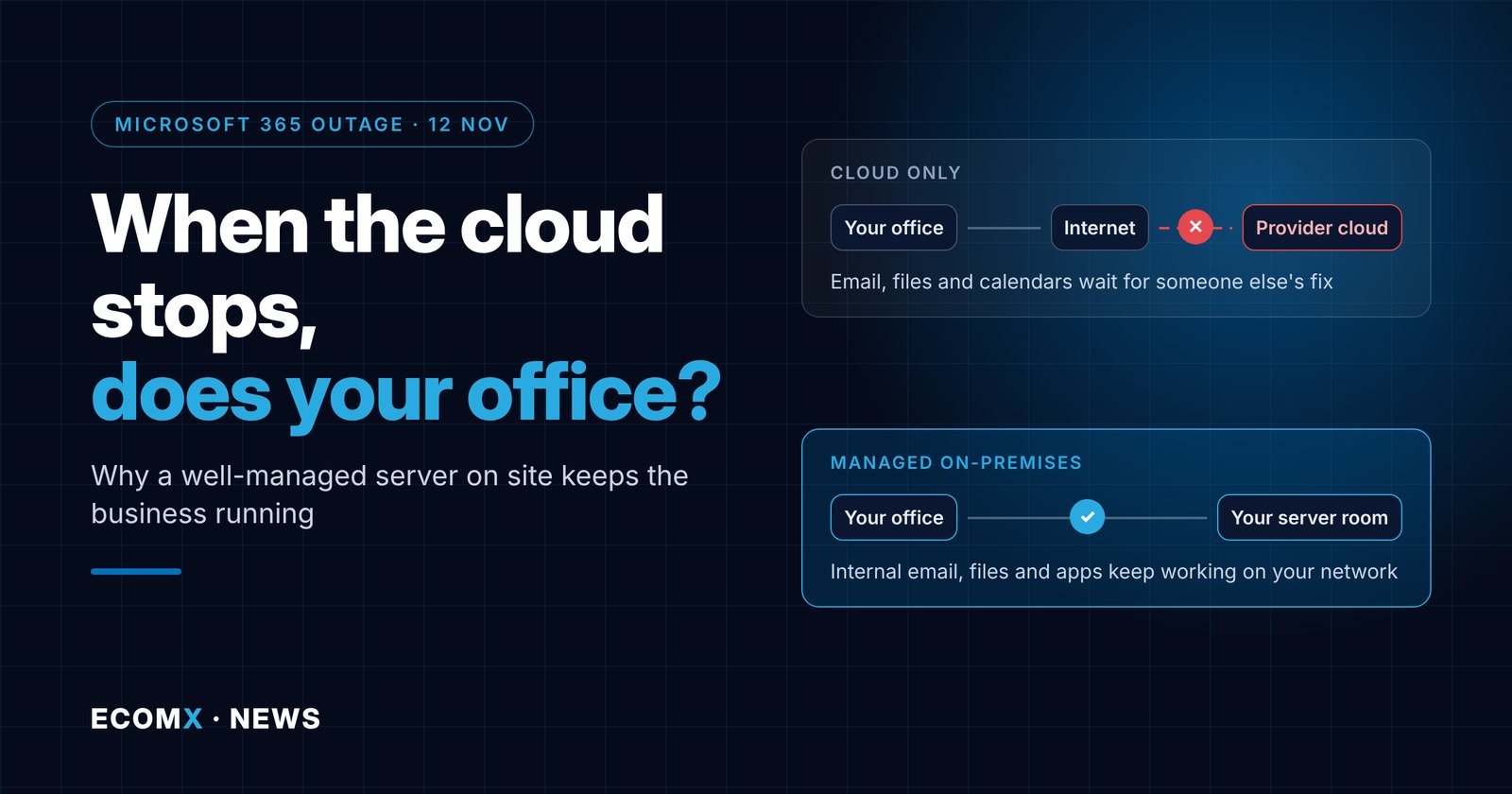
The Microsoft 365 outage that began on 12 November left South African businesses without email for around 24 hours. It is a good moment to ask which of your systems you actually control.
At about 18:20 on Thursday 12 November, Outlook stopped working for Microsoft 365 users across the world. Most people could not open their mailboxes at all, email delivery was delayed, and parts of Teams, SharePoint, OneDrive, Copilot and Defender that depend on Exchange Online were affected too. SARS was among the South African organisations that confirmed disruption.
Microsoft's preliminary post-incident report, issued on 15 November, puts the end of customer impact at 18:10 SAST on Friday 13 November: almost 24 hours of disruption. Microsoft then kept the service under extended monitoring while delayed mail was delivered, and closed the incident at about 06:15 on Saturday 14 November.
What went wrong, in Microsoft's own words
The report traces the outage to three things lining up at once in the gateway that sits in front of many Microsoft 365 services:
- A hidden software defect. A fix rolled out to these gateway servers in July carried a flaw that made servers lock up under certain loads. It ran worldwide for more than three months without showing itself, and Microsoft's load tests didn't catch it.
- Extra load. About fifteen hours earlier, Teams traffic had automatically moved onto the same gateway that serves Exchange Online, as part of normal operations.
- Less capacity. Nearly 14% of the gateway's servers were already out of service because of an unrelated problem the day before.
Together these tripped the defect. As servers locked up, traffic was moved to healthy ones, which then locked up in turn. Within two hours more than 80% of the servers had stopped responding, and the barriers meant to contain a failure to one region didn't hold. Teams, OneDrive and SharePoint could switch to other infrastructure; Exchange Online, Microsoft says, could not, for reasons of scale.
Recovery was slow because restored servers were swamped by waiting traffic and failed again, and because a defect dating from July could not simply be rolled back. The fix was an update returning the code to its earlier state, applied in stages across the fleet. Microsoft has added capacity, monitoring and safeguards against this kind of cascade, and says a final report with longer-term changes will follow by 20 November.
It is a candid report, and the safeguards it describes are real. But for the businesses that sat waiting, none of it made a difference. Microsoft's own redundancy did not save Exchange Online, and for a full working day there was nothing they or their IT provider could do except refresh the status page.
Outages are not rare
This was not a one-off. Microsoft 365 had a multi-hour outage in July 2026 as well. A worldwide measure of its uptime for the first quarter of 2026 came to 99.526%, the lowest since tracking began in 2013. That works out to about ten hours of interruption in the quarter.
South Africa carries an extra risk: most cloud traffic still travels over a few undersea cables. In March 2024, undersea cable failures between South Africa and Europe cut many local businesses off from Microsoft services for an afternoon, even though Microsoft's own systems were fine.
What the contract says: Microsoft commits to 99.9% monthly uptime for each service. If it falls short, the remedy is a credit on your subscription. It does not cover the sales, deadlines or staff hours you lost.
What a managed on-premises server gives you
An on-premises server sits in your own building, on your own network. When it is properly managed, it changes who is in control when something goes wrong.
- Work carries on during internet and cloud outages. Internal email, shared files, accounting packages and line-of-business systems keep running on your local network. Staff can keep working while the outside world catches up.
- One accountable party. With cloud services, your data and email depend on a chain of providers: the platform, its network, the undersea cables and your internet link. You have no direct line to most of them and no say in when they make changes. With a managed server, your IT provider answers to you directly, under an agreement you negotiated, with response times you can hold them to.
- You choose when things change. The 12 November outage was traced to a change Microsoft rolled out months earlier, which no customer could see or delay. On your own server, updates are tested and scheduled for a quiet time, with a way to roll back.
- You know where your data is. Personal information stays on hardware you own, in South Africa, which makes POPIA questions about where data is stored easy to answer.
- Predictable costs. There are no per-user subscription increases or exchange-rate surprises on the core systems you rely on every day.
"Properly managed" is the whole point
An unmanaged server in a cupboard is not resilience. It is a different risk. A well-run on-premises setup needs:
- Supported software, with security updates installed every month
- 24/7 monitoring of disks, temperature, services and backups
- Backups kept off-site as well as on-site, and restores tested regularly
- A UPS and battery backup sized for the server and network
- A properly configured firewall and controlled remote access
- A replacement plan before the hardware or software reaches end of life
You don't have to choose one or the other
For most businesses the best answer is hybrid: keep the systems you can't work without on a local server, and use cloud services for what they do well, such as collaboration, remote access and off-site backup. If the cloud fails, the office carries on. If the office has a problem, the cloud copy is there. Each side covers the other.
| When this fails… | Cloud only | Hybrid with a managed server |
|---|---|---|
| The provider's service | Email, files and calendars stop | Internal email, files and core apps keep running |
| Your internet link or an undersea cable | Everything in the cloud is out of reach | Local systems keep running; the cloud catches up later |
| Your office (fire, theft, power) | Staff work from anywhere | Restore from the off-site backup; cloud tools keep staff connected |
Frequently asked questions
Would an on-premises server have kept us working on 12 November?
For anything running on it, yes. Internal email, files and business systems on your own server keep working on your network. Email to and from outside addresses still needs an internet connection.
Is an on-premises server less secure than the cloud?
Not if it is properly managed. Patching, monitoring, off-site backups and a good firewall make the difference. Neglect is the risk, not the location.
Do we have to give up Microsoft 365?
No. A hybrid setup lets you keep Microsoft 365 for what works well and put your critical systems on a server you control.
What does Microsoft's SLA give us after an outage?
A service credit if a service falls below 99.9% uptime in a month. It does not compensate for lost business.
Book a free business continuity review
ECOMX will map which of your systems depend on outside providers, show what would stop in an outage like 12 November's, and recommend what belongs on a managed server, in the cloud, or both. We look after on-premises and cloud servers and backup and disaster recovery for businesses in Pretoria, Sandton and beyond, backed by our managed IT support agreements.
Sources
- Daily News Egypt (Africa): Microsoft outage hits South Africa
- Microsoft: Preliminary Post Incident Report EX1550543 / MO1550821, 15 November 2026 (issued to Microsoft 365 administrators)
- Digital Trends: Microsoft's longest outage in years is finally over
- NSAO: Microsoft 365 outage resolved, final update and incident timeline
- Forbes: Microsoft apologises for outage and reveals cause
- ABC News: Microsoft apologises for email disruption, says there was no hack
- SecurityWeek: Microsoft 365 outage disrupts Outlook, Exchange Online and Teams
- Cybersecurity News: Microsoft 365 services outage, July 2026
- Office 365 for IT Pros: Microsoft 365 quarterly uptime sinks to new low
- Bizcommunity: Microsoft outage and undersea cable failures, March 2024